Scholarship is broad and inclusive There has been some debate about the nature of scholarship. The Scholarship Spotlight team suggests the use of a broad and inclusive definition.
“A scholarship of teaching is not synonymous with excellent teaching. It requires a kind of “going-meta,” in which faculty frame and systematically investigate questions related to student learning”
Scholarship is a broad concept, which can mean different things to different people; here, we provide an inclusive account, in which we attempt to capture the breadth of scholarship activities of which we are aware of in the UK. Read more…
A popular conceptualisation of scholarship was proposed by Boyer (1990), in which he proposed that scholarship encapsulates four different academic endeavours. These comprise the scholarship of discovery (research), the scholarship of application (putting theory to practical use), the scholarship of integration (synthesising knowledge from different perspectives in new ways), and the scholarship of teaching (studying effective teaching and learning processes). Boyer conceived of all four activities as being the essential, core business of universities and academics, and did not propose any kind of hierarchy among them.
Figure 1: Visualising Scholarship – the Boyer Model
Scholarship of teaching and learning (SoTL)
Since Boyer’s seminal work, our collective understandings of scholarship have moved on. One key development has been the growth of one specific aspect of scholarship, the scholarship of teaching and learning (SoTL). SoTL has been variously defined, as summarised collectively by a group of US universities here. Trigwell (2013), recognising that SoTL was not always clearly defined across the sector, suggested that, by consensus, its purpose was to “enhance university teaching”, equipping teachers with knowledge to facilitate student learning, and informing higher education professional teacher development. Similarly, Fanghanel et al. (2016) also commented on a lack of consensus around the definition, and noted that SoTL comprises a set of tools that enable the development and recognition of teaching. In particular, they note that SoTL is “about practice development, curriculum enhancement, and student learning”; it requires “dissemination and impact”; it is “associated with change”; and it “requires engagement with students”.
SoTL is a popular lens through which to conceptualise scholarship, as represented by the International Society for the Scholarship of Teaching and Learning. For many people engaged in SoTL, it is a way to inform teaching, through innovation, through reflection, and through evaluation, and usually through sharing and dissemination. It may focus on a particular discipline (for example, how statistics are taught in psychology, or how field work is taught in archaeology), or it may be generic and interdisciplinary (for example, how to develop authentic assessments in any discipline). Through SoTL, an evidence base to underpin effective learning and teaching is developed.
However, SoTL is not the only conceptualisation of scholarship of which we are aware. Whilst SoTL tends to have at its heart an empirical and pedagogic approach, other forms of scholarship are also recognised within our universities. These can be described through reference to Boyer’s four activities (noting that we have already covered the scholarship of teaching).
Integration, for example, does not require empirical study; rather it is about drawing knowledge from different areas, and making novel links. An example might include a reflective discussion that draws together generic pedagogies with specific disciplinary knowledge, to propose innovations in curriculum design and development, with a view to improving course design. Another example of synthesis in scholarship might be the writing of a new text book, or the creation of a teaching resource, drawing on knowledge from different areas. This webpage, drawing on different perspectives around scholarship, could in fact be considered a scholarly synthesis! None of these examples fit neatly into SoTL, and none are empirical in nature; however, an empirical SoTL study may well follow, drawing on the ideas presented, implementing them, and evaluating them in practice.
Application, can also be an important aspect of scholarship. This might be the application of a theory, such as developing an outreach programme that recognises the role of cultural and social capital in student engagement with higher education. It might also be the translation of practice or signature pedagogies from one discipline into another, such as learning about problem-based learning in a medical education setting and introducing it in your History class. Or it could be the application of the findings of someone else’s SoTL work, whereby you implement the innovation that they developed, testing and evaluating it in your own context.
Research, also has its place in the scholarship world, although we note that sometimes it is overemphasised in contexts where scholarship is still being established. As Hulme (2022) notes, universities understand research, value it, and recognise how to measure it, whereas scholarship is still misunderstood in some institutions, and ways to measure and understand it are not always made explicit. It is, of course, possible to conduct rigorous research on the processes of higher education and student learning; to draw on a theoretical foundation, to conduct empirical studies (both quantitative and/or qualitative), and to draw conclusions which further inform and develop theory. Outputs in traditional research journals are often what is recognised as ‘formal’ scholarship in such universities. But we argue that scholarship can be much more than this.
In reality, there is much crossover between the four elements of scholarship proposed by Boyer. SoTL and research often have much in common, and application frequently involves integration as its first steps. But it is possible to pin down the attributes that are needed in order to qualify a piece of work or a project as ‘scholarship’.
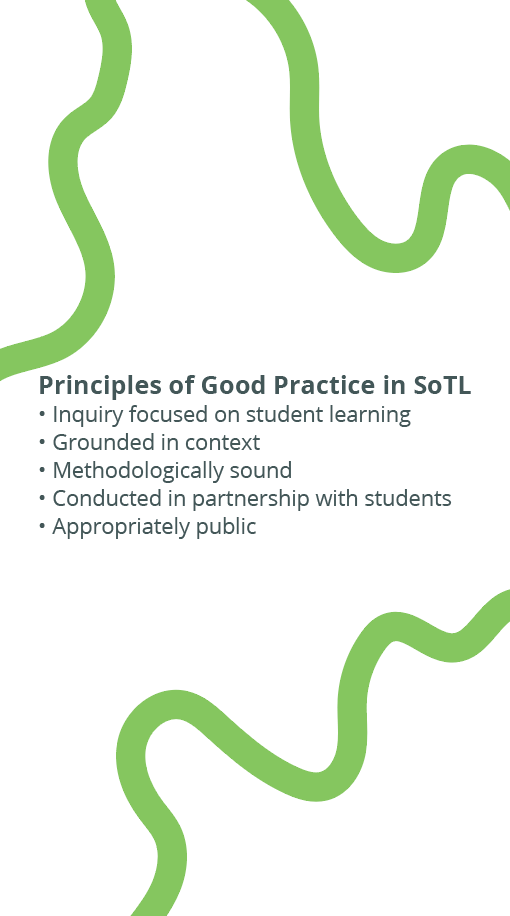
Firstly, scholarship is a tool to improve higher education, develop the teaching profession, and enhance student learning. Higher education is the focus of scholarship.
Secondly, according to Shulman (1999), “An act of intelligence or artistic creation becomes scholarship when it possesses at least three attributes: it becomes public, it becomes an object of critical review and evaluation by members of one’s own community, and members of one’s community begin to use, build upon, and develop those acts of mind and creation”. In other words, the work must be shared, reviewed, and used.
Finally, it’s important to note that sharing or disseminating scholarship does not only mean publishing in journals. The scholarly community recognises many different types of output. Text books, policy reports, webinars, book chapters, magazine articles, letters to professional bulletins, grey literature, blogs, quality assurance processes and discussions, teaching meetings, podcasts, vodcasts, cartoon drawings, sharing course documentation or open educational resources, conference presentations and other talks, and so many other formats – probably including some that have not yet been invented – can be valid and legitimate ways to share. We share to communicate with those who will find our ideas useful, rather than to claim esteem by association with a particular journal, to gain citations, or to count our impact factor.
So how can we measure & evaluate the effectiveness of scholarship?
We need to consider its reach (how far it travels when it is shared, including whether it reaches hard to reach groups), its value (how it is perceived and appreciated by others), and its impact (how and where it is used and the difference it makes). These are the important factors in ‘measuring’ and evaluating scholarship.
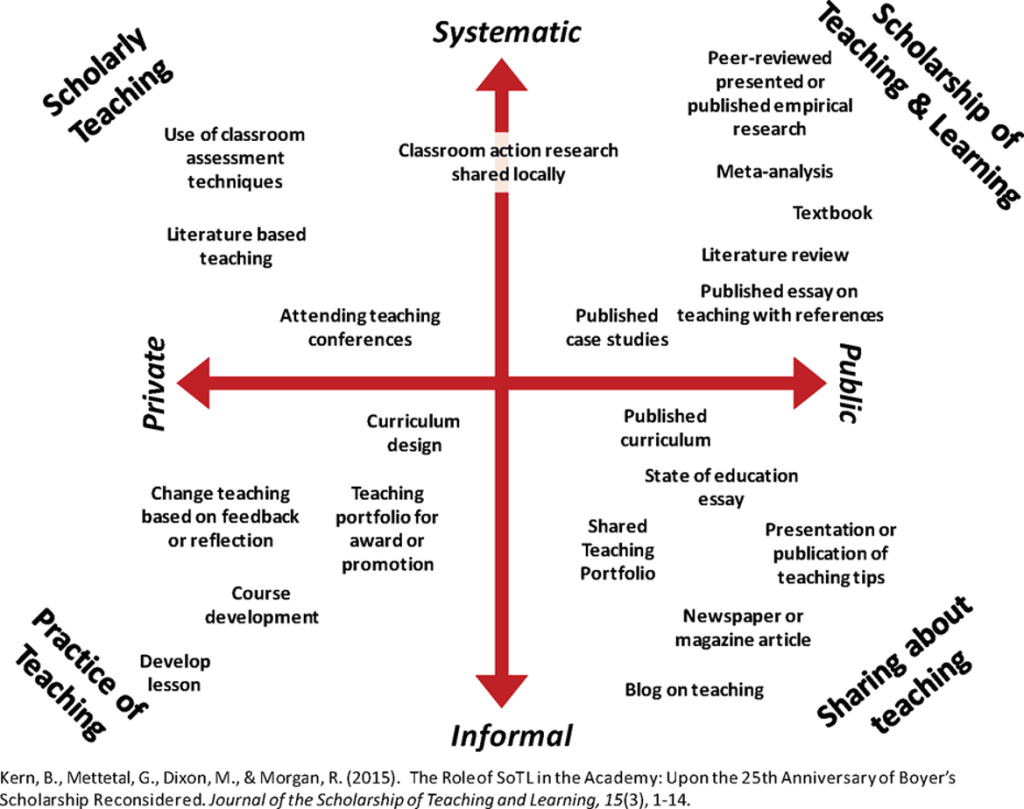
It’s useful to begin to map out your scholarship activities to reflect on and develop your practice. The Dimensions of Activities Related to Teaching (DART) model (Kern et al. 2015) may be helpful for you to visualise your scholarship activities.
Figure 2: Dimensions of Activities relating to Teaching (DART) Model
Boyer, E. L. (1997) Scholarship Reconsidered: Priorities of the Professoriate. Jossey Bass.
Fanghanel, J. (2013). Going Public with Pedagogical Inquiries: SoTL as a Methodology for Faculty Professional Development. Teaching & Learning Inquiry: The ISSOTL Journal, 1(1), 59–70. https://doi.org/10.2979/teachlearninqu.1.1.59
Hulme, J. (2022) Supporting and developing teaching-focused individuals to professorial level: Career progression across boundaries. In E. McIntosh and D. Nutt (Eds) The Impact of the Integrated Practitioner in Higher Education Studies in Third Space Professionalism. Routledge.
Hutchings, P and Shulman, L. S. (1999) The Scholarship of Teaching: New Elaborations, New Developments , Change: The Magazine of Higher Learning, 31(5), 10-15, https://doi.org/10.1080/00091389909604218
Kern, B., Mettetal, G., Dixson, M., & Morgan, R. K. (2015). The role of SoTL in the academy: Upon the 25th anniversary of Boyer’s Scholarship Reconsidered. Journal of the Scholarship of Teaching and Learning, 15:3, 1–14. https://doi.org/10.14434/josotl.v15i3.13623
Martin, E., Benjamin, J., Prosser, M., and Trigwell, K. (1999). Scholarship of teaching: a study of the approaches of academic staff, in Rust, C. (ed.) Improving Student Learning: Improving Student Learning Outcomes. Oxford, Oxford Centre for Staff and Learning Development.
Richlin, L., 2001. Scholarly Teaching and the Scholarship of Teaching. New Directions for Teaching and Learning, 2001(86), pp.57-68. https://doi.org/10.1002/tl.16
Trigwell, K. (2013). Evidence of the Impact of Scholarship of Teaching and Learning Purposes. Teaching & Learning Inquiry: The ISSOTL Journal, 1(1), 95–105. https://doi.org/10.2979/teachlearninqu.1.1.95






 Scholarship Spotlight