
Doing Scholarship
There are many ways you can share your ideas and learn from others.

Examples include attending and/or presenting at educational conferences and online webinars. It could be as a guest for LTHEchat or by sharing your work on platforms similar to the National Teaching Repository such as Figshare or Zenodo. ResearchGate and Academia.edu are also useful to look at and contribute to. You might want to consider creating a blog to share your work or write a post on LinkedIn. It can really help to read other educator’s posts to see how impactful they can be. Other spaces to share your ideas include podcasts, videos and infographic posters. These can also be shared via social media. within Bluesky for example there a growing network of educators to interact with. You can find a Bluesky user guide for academics and a starter pack for who you might want to follow on the social media for learning website.
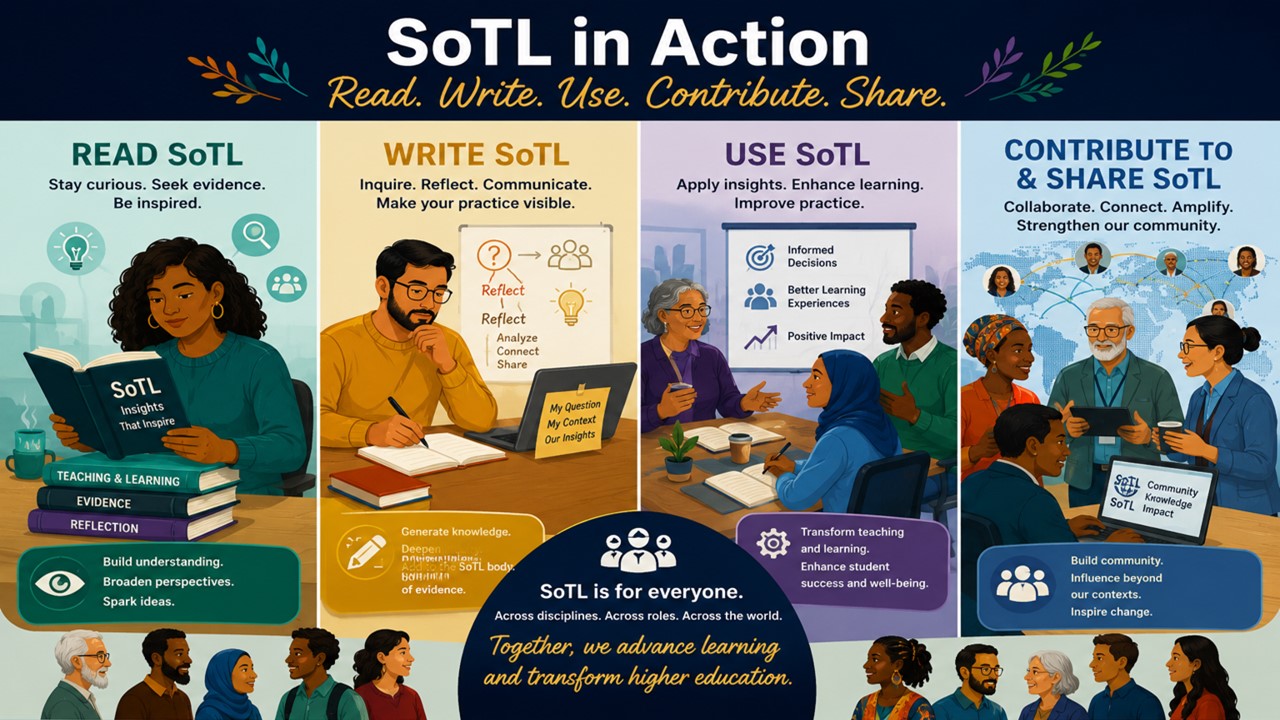
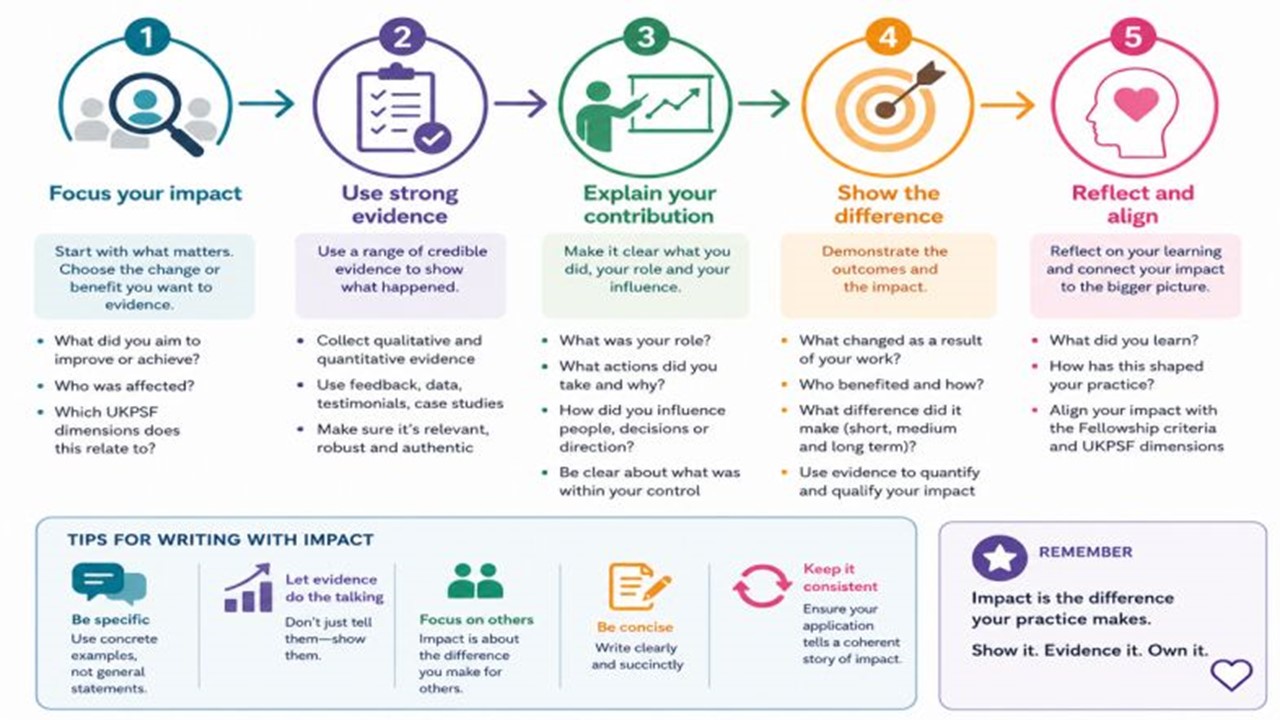
The Scholarship of Teaching and Learning (SoTL) draws on a rich range of frameworks, models, and visual representations to support inquiry, reflection, and impact in educational practice. This curated collection brings together a selection of widely used and emerging SoTL perspectives, designed to help educators explore, interpret, and apply evidence-informed approaches to teaching and learning.
Whether you are new to SoTL or looking to deepen your practice, these resources offer multiple entry points, highlighting key concepts, relationships, and processes in accessible formats. They can be used to guide project design, support critical reflection, and communicate ideas with clarity across disciplines and contexts.
Useful Frameworks
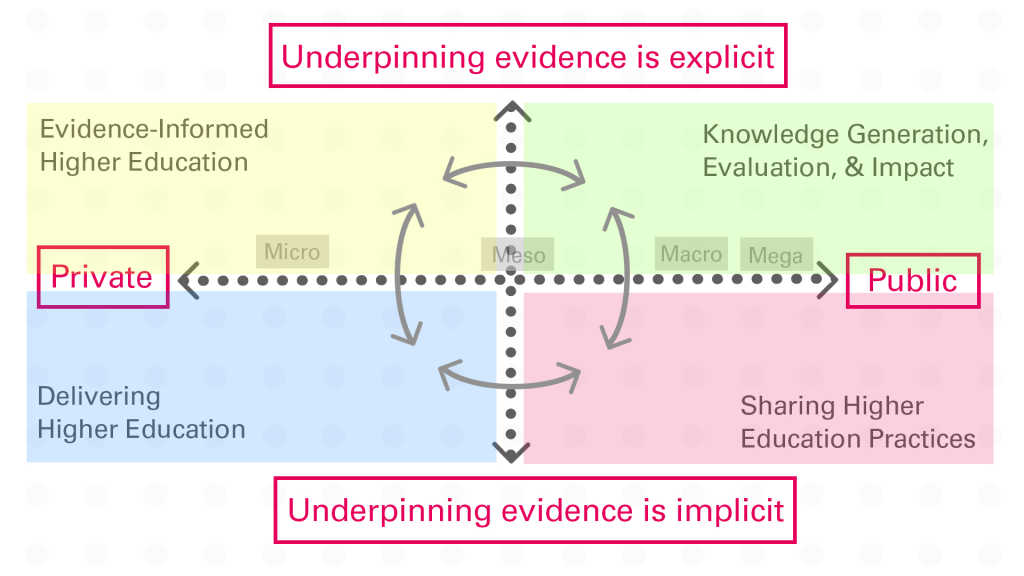
The Description of Activity Related to Scholarship in Higher Education (DARSHE) framework: (Gann & Hulme, 2025) is a practical tool to help individuals reflect on and develop their scholarship.
The framework is organised into four quadrants, shaped by two key dimensions: whether activity is private (e.g. confined to one’s own teaching context) or public, (shared with colleagues or wider audiences) and whether supporting evidence is implicit or explicit.
Scholarship often begins in our routine teaching practice – Delivering Higher Education – as we encounter challenges or seek to improve student understanding or engagement, we often draw upon (and contribute to) Evidence-Informed Higher Education. From here we may communicate our ideas through blogs, podcasts or toolkits (Sharing Higher Education) and/or make our evidence-based work explicit through Knowledge Generation, Evaluation and Impact. A unique feature of the framework is that all four aspects (quadrants) are equally valuable and interconnected.
Why don’t you have a go yourself by taking one aspect of your work and mapping it across the DARSHE framework to identify which quadrants you might want to develop?
Gann, R.J., Hulme, J.A. Scholarship reimagined: creating the DARSHE, an inclusive and flexible framework for developing scholarship in higher education. High Educ (2025). https://doi.org/10.1007/s10734-025-01562-5
Hulme, J.A. & Gann, R.J. (2025). Introducing the DARSHE: moving beyond the debate about ‘contested definitions’ of scholarship? ANTF blog. https://ntf-association.com/introducing-the-darshe-moving-beyond-the-debate-about-contested-definitions-of-scholarship/
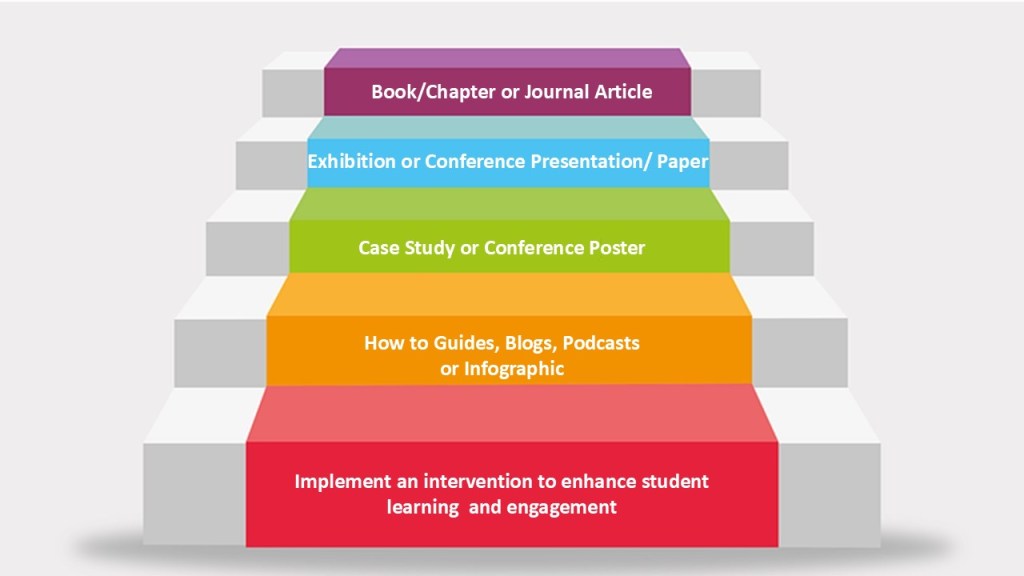
The SOTL Staircase: At a time when evidence-informed teaching and reflective professional practice are gaining prominence, the SoTL staircase (Beckingham, 2025) provides educators with practical approaches to share their work that can help to build both their confidence and the visibility of their scholarly work. Each step reflects a different form of dissemination. It illustrates how educators can build confidence and capacity in SoTL through staged dissemination. Beginning with informal conversations, practitioners reflect on teaching interventions, including successes and failures, to refine practice. Subsequent steps involve creating and publicly sharing accessible outputs such as blogs or guides, or developing structured case studies or posters. Presenting at conferences and publishing articles or books represent advanced stages, requiring deeper critical engagement and validation. Each step expands impact, encourages collaboration, involves students as partners, and strengthens professional identity, ultimately contributing to disciplinary knowledge and sustained enhancement of student learning and engagement.
Beckingham, S. (2025) The SoTL Staircase. SoTL@SHU Blog.
https://blog.shu.ac.uk/sotl/sotl-staircase/
Beckingham, S. (2025) Making SoTL Visible: Every Step Counts. The EuroSotl Network. https://eurosotl.org/?p=1990
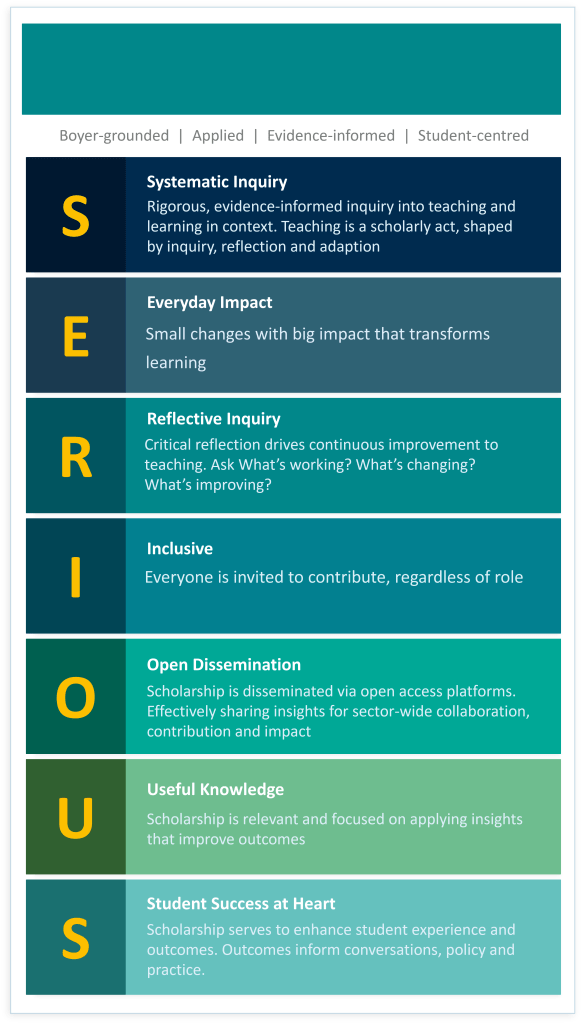
At Arden University, we are Serious about Scholarship. Scholarship isn’t something colleagues do on top of the day job. Scholarship is the day job.
Scholarship is the small, often unnoticed, yet profoundly impactful work that quietly transforms learning, teaching, and the student experience. Our approach starts from the belief that everyone is already a scholar. The challenge is helping colleagues recognise it, capture it, and share it. To make that tangible, we developed the SERIOUS about Scholarship model (Irving-Bell, 2026), a practical framework that names the things we already value, and gives colleagues a shared language for them:
- Scholarship as Practice
- Everyday Impact
- Reflective Inquiry
- Inclusive Engagement
- Open Practice
- Useful Knowledge
- Sector Contribution
Nurturing scholarship, for us, is about creating the conditions in which it can flourish. That means designing spaces where colleagues can think aloud, try things, fail safely, and celebrate the small wins. To support colleagues, we have our ‘Lunch and Learn series’, school-based conferences, writing groups, compendiums, reciprocal visiting scholars, a virtual staffroom. As colleagues gather evidence of the impact of their practice, we ensure reward and recognition via promotion pathways, Advance HE PSF Fellowship, internal awards, and our Teaching Scholars Scheme; visible, supported routes that say, your scholarship matters here.
It also means believing in people before they believe in themselves. Helping an emerging scholar audit what they already do, build a profile, find their tribe, and amplify their voice. Whether someone is a SoTL Explorer dipping a toe in, or a Scholar already shaping practice across the sector, the invitation is the same; come and join us.
Small stuff equals big impact, and at Arden, thought our approach ‘SERIOUS’ about scholarship, we are building a thriving scholarly culture.
A collection of recources created by Earle Abrahamson
LTHEchat
About: The Learning and Teaching in Higher Education Chat #LTHEchat is a weekly conversation for educators that takes place on Bluesky Wednesday 8-9pm. Guests can volunteer to provide a topic for discussion along with six questions. To promote the chat and chosen focus, the guests also write a short blog post. This is a great opportunity to share any resources, for example books, papers and videos. You can follow @LTHEchat on Bluesky and find out more on the LTHEchat website. If you would like to volunteer to be a guest please complete this form to find out more.
Read more…
Guidance on getting started with LTHEchat
Take a look at this slidedeck which explains how to get started and what to expect.
Examples of LTHEchats focussing on scholarship:
Breaking boundaries: career progression and education focussed roles with by David Walker @drdjwalker and Susan Smith @SmithySusanA
Transitions into Scholarship of Teaching and Learning (SoTL) with Linnea Soler @DrLinneaSoler and Nathalie Sheridan @drnsheridan
Bringing Scholarship to Life with Sarah Broadberry @DrSBroadberry
Support for Scholarship of Teaching and Learning (SoTL) with Christina Elliott @Dr_CL_Elliott, Scott Turner @scottturneruon and Sarah Honeychurch @NomadWarMachine
4 Pillars of SoTL with Laura Stinson @lstinson81

National Teaching Repository
About: The National Teaching Repository (NTR) is an open access online searchable database where tried and tested strategies ‘that work’ are housed and harvested. It’s a space where colleagues uploaded and shared teaching resources, pedagogical research, approaches and ideas. Showcased in a range of non-traditional research formats including data, books, reports, code, videos, images, audio recordings, posters, and presentations. Each item has a unique digital object identifier (DOI). Through sharing these resources, colleagues help others, while securing recognition and acknowledgement for the resources, and are able to evidence the impact of their work in practice. While currently paused to new submissions, the National Teaching Repository is a space that anyone can search and access hands-on, practical ideas and resources, off the shelf ready to use or to adapt, for implementation in their own settings. You can follow the National Teaching Repository on Bluesky.
Read more…
Examples of SoTL resources shared:
Scholarly, Scholarship, SoTL Cheat Sheet by Nathalie Tasler
A practical approach to amplifying scholarly practice through digital technology by Sue Beckingham and Dawne Irving-Bell
Speed SOTL Discussion Cards – Assessment by Laura Stinson and Kate Cuthbert.
Why Engage with the Scholarship of Teaching and Learning? by Anne Tierney

